Cutting 60-degree diamonds

Yesterday I was talking about getting organized to make my “Diamond Explosion” quilt and was pleased to find that I could piece the 60-degree diamonds easily.

Now it was time to cut the real fabrics and get started!!

I knew that I could cut the diamonds just using my regular straight ruler….I had done it back in May…..

….but it wouldn’t be as easy since I needed to cut the fabrics one at a time, rather than having them stitched together.

I really like Deb Tucker Rulers and decided to purchase her 60-degree wedge tool…..

Using this tool, I can cut out strips of fabric and then cut the diamonds easily from the strips!!

I settled on a 3-inch finished diamond which meant that my strip was cut 3.5-inches.

The first step was to make the initial cut to start the diamond shape. To do this, I placed the ruler on the strip, being sure that the lines were parallel to the cut edge of the strip…..

A quick slice, and we were ready to go…..

Next, I placed the ruler so that the 6.5-inch mark was at the point I had just created (6.5….because it was 2 times the 3-inch finished size, plus 1/2 inch for the seam allowance)….

Another slice…..

…..and I had a diamond……

As I pieced, I ended up needing some half diamonds and went back to the ruler for those.

In this case, the ruler was placed on the 3.5-inch line……

…..which meant that the top point was missing…..

And, NO….that was not a mistake!!

Having the point clipped off meant that it was SUPER easy to line the piece up when I was ready to sew it in place…..

Once I had a bunch of diamonds cut, I immediately started piecing……

…and then realized that I had other pieces that should have been added BEFORE I sewed these!!!

So, I will leave it here……with seam ripper in hand!!

Come back next week for more of the diamond piecing odyssey!!!

The Painter’s Tape Solution

In yesterday’s post, I described my newest piecing project…. a charity quilt using the “Whirlpool” block…..

I did make one change in the piecing layout. Instead of piecing the diamond blocks as two half-square triangle squares, I decided to piece them as one unit made up of a rectangle of the scrap fabric and two triangles of the background fabric…..

I was piecing these using the “snowball” technique where you place a background square at the end of the rectangle, sew on the diagonal, and press the resulting triangle over to finish the rectangle.

BUT, I was having trouble getting my lines to be straight!!

After some thought, I figured out a solution……

After I figured out how to position the tape, it was fast and easy to finish piecing the 80 required rectangles and get on with the design.

What would quilters do without Painter’s Tape!!!!

Do you have a favorite trick for using this special tool??

Prewound Bobbins….yea or nay??

I HATE to wind bobbins, especially when I am in the middle of a project and have to stop and unthread everything.

I have recently been hearing people talking about pre-wound bobbins and my initial, frugal reaction was “why would I want to spend money on those?”

THEN, I started thinking about the fact that I would have been paying money for the thread anyway, and what I was saving was TIME, and we all know how valuable IT is!!

So, I relaxed my purse strings and purchased two sets of Pre-wound bobbins for Julio, my Juki Sit-Down long arm……

I loaded a cream-colored one into the bobbin casing and started quilting……

Okay….the top looks GREAT!!!

But the BIG test is how the back looks…..

WOW….even on this loose-weaved practice fabric, the tension looks amazing.

I think that I have found a keeper!!!

So where are you…..Prewound Bobbins………

Quilting tool with a story!!

Like most quilters, I cannot live without my rotary cutter!!

But even more than that, I love the story surrounding my first rotary cutter…….

Let me set the stage for you…..

It is December of 1985 and my husband and I have traveled from Canberra Australia and are visiting our parents in Abilene, Texas. And, more importantly to them, we have a 6-month old grandson in tow!!

My ever-resourceful Father bought us a Polaroid camera and said that he wanted to be a member of the “picture of the month club”!! The idea is that we would mail one photo each month so that he could see his grandson grow up. Remember, this was LONG before the digital age!!!

The day before we left to return to Canberra, Dad took me to a discount store to purchase more film for the camera. As we walked past the craft department, a package similar to this one caught my eye…..

….except that the rotary cutter was smaller, the mat was skinnier and there was a 4.5-inch plexiglass ruler included.

Needless to say, I was intrigued!!!!

Dad saw my interest and immediately picked it up and put it in our basket!!

I found a place to tuck it into the suitcase and happily carried it home.

It took another few years before I REALLY learned how to use it and, amazingly I still own the original cutter……

….although it is now designated for “paper use only”.

It was typical that my Dad saw my interest and jumped in to encourage me….that is just who he was!!!

Do you have a favorite quilting memory?

Baste it fast with fusible

Over the years, I have fallen in love with fusible batting. It is easier than pinning and doesn’t have the fumes and mess associated with a basting spray.

My favorite brand is Hobbes Heirloom fusible…..

There are a few things that you have to do differently than with non-fusible batting.

First of all, it comes in sheets that are slightly stuck together….

You need to be careful as you peel them apart …..

…but you will eventually get to the single layer…..

It is often fairly wrinkled…..

….and I would suggest that you hang it up or lay it out for a while. You can put it into the dryer, but don’t leave it in too long!!

I normally start with the batting on the bottom and iron the backing fabric on first….

If you accidentally iron a wrinkle into the backing, don’t sweat it!!! Instead, you can simply pull the fabric apart from the batting and re-iron it.

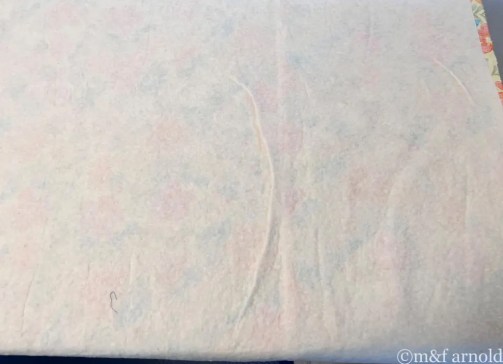
Often the batting isn’t completely wrinkle-free and sometimes ends up looking like this…..

Again, don’t worry about it. Once the quilting is completed, you will never notice the wrinkle!!

After the backing and batting are securely fused, I add the quilt top and iron it as well…….

It is easiest to start ironing in the center of the quilt and slowly work out to the edges.

I normally use a LOT of steam for this process and it seems to work well.

After the top is fused, I like to lay it out flat for 15-20 minutes to let it cool.

The final step is to trim the excess batting and backing fabric off (leaving at least 2 inches on each side). Sometimes I will add a few safety pins along the edge to just hold it in place a bit more.

I can baste a lap size quilt in about 15 minutes, just laying it out on my ironing board. I baste Queen size quilts on my garage floor but use this same 2-part process.

Do you have a favorite batting???

Do you like the quilt that I am using for this demonstration? If you do, you can download a FREE pattern for this quilt HERE