More threadwork!!

Yesterday we added the first layer of meadow grass to Sadie’s background……

Now it is time to work my way UP!!

I prepared the next (dark green) section in the same way that I did the first one. I started with wool, added some strings and other bits, and then added LOTS of thread……

Since this section is much darker, I decided to use King Tut #989 (Malachite) thread for the stitching. Since it is another variegated thread, it adds a nice movement to the stitching.

When I washed it out, I was upset that it had shrunk so much and didn’t come close to covering the dark green painted area…..

Fortunately, the piece stretched in width a WHOLE lot…..

I made use of that overage and filled in the blank areas and Sadie now has TWO layers of meadow…..

As I moved further up the piece (and further BACK in perspective) I wanted the threadwork to become more dense with less detail.

I also wanted to add an area that had a different look to it.

To accomplish this I started my stitching with a line of “back and forth” stitching…..

…..and filled in with overlapping small circles…..

I also threw in some areas of straight stitching among the circles.

Note that these circles are NOT perfectly formed and are really messy. To me, that is part of the charm of this technique!!!

Once these two sections were pinned in place……

….it was time to tackle the final “really dark” area.

Again, since this is even further in the back, I wanted it to be denser stitching.

I chose to do larger overlapping circles. In my free-motion quilting class, I call this “Messy Hairdo” and it is one of the easiest FMQ patterns to master…..

Since I wasn’t adding any wool roving or other items to the sandwich, I decided to use a non-fusible washout material……
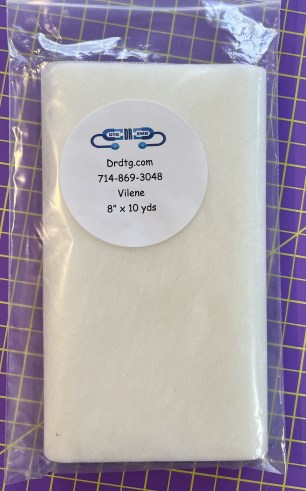
It can be purchased on Amazon….

I ended up using three layers of the material so that I would have a good base for my stitching. This may have been overkill but it gave me more confidence in stitching.

I was happy with the look…..

….but it REALLY looked good when it was attached to the meadow…..

The reason I have a “fill-in” Sadie is because I was worried about continuing to move her back and forth. She was starting to fray a bit!!!

So the ONLY things left to do are the trees in the very back. They concern me greatly!!

Come back tomorrow and see how I solved this problem!!!

. . . . . . . . . . . . . . . . . . . . . . . . . . . . . . . . . . . . . . . . . . .

In this blog, I post stories about creativity, techniques, tools of the trade, and lots more about the wonderful art of quilting. If you are enjoying these posts, please subscribe to be notified of each new blog as it becomes available.

Stabilize me!!

A month or so ago, I posted about finishing up a Thread-painting that one of my friends had started…..

It was stabilized with a super-heavy backing which made the stitching easy to do.

Unfortunately, it meant that the piece could not be quilted so I ended up just turning it into a piece of wall art.

NOW I am planning to make a similar one for myself……

….but I can’t figure out what type of stabilizer to use.

I visited my local JoAnn’s and found tons of different types of interfacing!! Completely overwhelmed, I picked four types to bring home and try.

I planned my test pieces so that one section was sewn straight on the backing fabric and one section was on a piece of fabric that was fused down.

Here are my results……

The first was Pellon 931 which is called a” Fusible Midweight”.

Stitching on the fused fabrics worked okay, but there is definite puckering on the other side….

Next was Pellon 987 which is a “White Fusible Fleece”….

. I had great hopes for this version as it would give the piece a bit of texture. Alas, there was TOO much texture……

….but not TOO bad.

Next was Pellon 808…. “Craft-Fuse”…..

This one was the worst for distortion……

Finally, I tried Pellon 80 (Heavyweight Stabilizer). This one is different because you SEW it in rather than fuse it on…….

This provided the least amount of distortion…..

All of these stabilizers worked well on the areas where another fabric had been fused to the backing but this one was the only one that worked equally well with just one layer of fabric.

I think the fact that it isn’t physically attached (fused) gives it room to shift a bit.

The thing that I don’t like about this stabilizer is that it is thick and will definitely turn the piece into an art piece rather than a quilt.

So, that is where I stand right now and I could really use your help…..

What stabilizers do you use??

A free creative morning….

Yesterday morning I set 3 hours aside for creative ventures and I was scared stiff!!

WHY is that such a scary proposition??

I knew the project that I wanted to play with, but it is something that I have never tried before and that scares me to death!!!

It shouldn’t but it sure does!!

OKAY….here is the project!!

During COVID days, one of our guild members (Sharon) took an online course from Michelle Mischkulnig of Chelle Textiles. In that class, she created this amazing threadwork scarf…..

I fell in love with it and immediately got onto the website and started reading about her process. She uses a water-soluble Vilene as the base for all of the stitching. The Vilene is sticky on one side, so the idea is to place lots of threads, yarns, and embellishments on the sticky side of the Vilene and then place another piece over the top, sticking the two stabilizers together with all of the bits in the middle. Then you quilt like mad to connect all of the bits and pieces. When the stabilizer is washed out, it leaves a lovely lacy scarf.

Now, I didn’t really want to make a scarf but I loved the idea of using this technique.

THE INSPIRATION…….Back in April, I posted this photo of a Botero painting and said that I found it inspiring…..

…but could I use this new technique to make some similar??

My first decision was to not work directly on the Vilene but to use a piece of dyed cheesecloth as my base. I was originally thinking about a green background for the bottom but found a piece that was already dyed brown and decided to just use it…..

I adhered the stabilizer to one side of the cheesecloth…..

My first plan was to cover this piece of cheesecloth with lots of threads and other bits…..

…but I quickly realized that I wanted to STITCH these on and not just lay them down. So I sat down to stitch.

But then I got worried and decided that I needed to make a test piece first. So I prepared a smaller piece and started stitching…..

….only to find out that the fabric bunched up a lot with the stitching.

I added a 2nd piece of stabilizer to the back and that made all the difference….

With the big piece double stabilized, it was time to start some stitching, and MAN was it fun…..

I started with a variegated green thread and put the pedal down and FLEW across the piece. It was so freeing to stitch with such abandon!!

I did have to stop once when my needle got gunked up with the adhesive, but a quick clean with an alcohol wipe solved that problem….

At the end of my scary creative time, I had this to show……

Where am I going next with this?

THAT question makes my head hurt!!

Come back for more and, if you have suggestions, PLEASE pass them on!!

Practice makes…..one crazy!!!

The last step on my Meadow Art project is to add the daisies. In my last blog installment about this project, I showed some of my attempts and concluded that the best way to do them was to do the initial work on the machine and then use embroidery floss to finish the petals (#4).

THEN, I started thinking about using Perle cotton in the bobbin and working the flowers from the back. The first few attempts were not successful as I didn’t have the tension set correctly……

I kept changing settings until it looked like this…..

Those are better and would work for another type of flower, but not for these daisies!!

I made several other tries using a smaller Perle cotton (size 5) in the needle but it just didn’t look right.

In the end, I moved back to my plan of machine work under and hand-work over.

I decided to color in the centers to give me an idea of exactly where I wanted the flowers to fall…..

….. and then stitched the first five flowers on the machine The two on the left have been finished completely with hand stitching and centers stitched……..

They are not nearly as good as the ones on the sample, but they do look good on the piece. I also noticed that the ones on the sample have some shading on certain sides of the petals so I am going to explore that further before I finish the artwork.

The important thing is that I am still enjoying this process and am already starting to think of other ideas that I want to do in this same format!!

Off to a good start

Yesterday I started on my new Meadow Art project and had SO much fun with it!!

As I started, I decided to stabilize the initial fabric base so that there wouldn’t be too much scrunching up as I added stitching. I used a thin fabric with fusing on one side and ironed the two pieces together …..

The fabric was sized at 14×19 inches, although it looked a LOT bigger than that when I was staring at a blank canvas…..

Following the instructions, I started tearing strips of fabric, making sure that I had lots of strings on the edges. You know, the things that we normally HATE when we tear fabric…..

I also cut/tore burlap, flannel and silk and added those to the mix. When it looked balanced…..

…. I took it to the machine and sewed each piece down, staying close to the torn edge……

Next, I started adding bits of trim and lace…..

….and went back to the machine to secure them to the background. At this point I realized just how much I like my Juki machine……

It is a workhorse!!!

After each step, I ironed the piece from the back, just to make sure that it stayed relatively flat…..

I failed to take a photo of the next step, but I used cotton thread to sew in some flower stems, grass and other linear elements.

At this point the instructions suggested putting a heavier yarn in the bobbin and sewing textural lines but I didn’t really want to mess with my bobbin so decided to switch to my other sewing machine and couch the threads instead. I had this thread/yarn in my stash……

….and thought that the extra texture might be nice.

My trusty Viking machine came to the rescue and I was able to use the couching foot……

…..to attach the yarn.

This is where I stopped on the first day……

….and I am really happy with the texture that has appeared. My only concern is whether the darker threads will be covered by the paint, but I think that I can make it work even if they don’t cover well.

The next step is to apply paint and then to start doing more embellishments.

I CAN’T WAIT!!!!